Complete Guide
Baby Gate: The Complete Guide
Pressure or hardware-mounted, top of stairs or doorway: how to choose, fit and use a baby gate safely.

The moment a baby starts moving, your home changes from a safe nest into a landscape of stairs, doorways and hazards that were invisible before. A baby gate is one of the simplest, most effective tools for keeping a crawling or walking child out of danger. This complete guide explains the types of baby gate, where to fit them, the features that matter for safety, and how to choose and install one that actually does its job. Along the way you will find well known models worth comparing so you can baby-proof without overspending.
Babiespedia is reader-supported. When you buy through links on our site we may earn a small commission, at no extra cost to you. We only feature products we believe parents will find genuinely useful.
What a baby gate is for
A baby gate is a barrier that blocks a doorway, hallway or the top or bottom of a staircase to stop a young child reaching somewhere unsafe. It is not a toy or a fence to leave a baby behind unsupervised. Think of it as a way to shrink your home into safe zones during the busy months when a child is mobile but has no sense of danger.
- Blocking stairs is the most common reason parents buy a gate, since falls down steps are a leading cause of injury for this age group.
- Closing off rooms such as kitchens, bathrooms, home offices and utility areas keeps children away from ovens, cleaning products and cords.
- Creating a safe play area lets you step away for a moment to answer the door or use the bathroom with less worry.
Most families start thinking about gates once a baby is rolling or scooting, usually around six months, and want them fitted before crawling begins in earnest. If you are still assembling the rest of the nursery, our newborn guide covers what to prepare first.
The main types of baby gate
Gates fall into two broad families, and knowing the difference is the single most important thing you can learn before buying, because the wrong type in the wrong place is genuinely dangerous.
- Pressure-mounted gates stay in place by pushing against the wall or door frame with rubber pads and a tension bar. They need no drilling, so they are ideal for renters and easy to move. They are suited to doorways and the bottom of stairs, never the top.
- Hardware-mounted gates screw directly into the wall or frame. They are far stronger and cannot be pushed out, which makes them the only safe choice for the top of a staircase.
- Retractable gates use a mesh panel that rolls away when not in use, handy for tidy hallways and occasional use.
- Freestanding or configurable barriers and playpen-style panels enclose a space in the middle of a room rather than fitting a fixed opening. If that is your goal, compare options in our best playpen guide.
Tip: Never use a pressure-mounted gate at the top of stairs. The bottom bar creates a trip hazard and the whole gate can be dislodged if a child leans on it. The top of a staircase always calls for a hardware-mounted gate.

Where to fit a gate
A gate only helps if it is in the right place, and every home has different pinch points. Walk through your space at a baby's eye level and look for the routes a curious crawler would take.
- Top of the stairs: a hardware-mounted gate that swings away from the steps, never over them, so it cannot open into open air.
- Bottom of the stairs: a gate here stops a child climbing up unsupervised, which is just as important as stopping a fall down.
- Kitchen doorway: keeps little hands away from hot surfaces, sharp tools and cleaning products.
- Rooms with hazards: home offices with cables, garages, laundry rooms and any space with heavy or unstable furniture.
Measure the opening carefully before you buy. Gates are sold to fit a range of widths, and many can be extended with add-on panels for wider gaps, but there is a limit to how far one gate stretches. The U.S. Consumer Product Safety Commission publishes guidance on stair and gate hazards that is worth a quick read before you install.
Popular baby gates compared
A handful of models turn up again and again on parent lists because they balance safety, ease of use and price. The table below groups reliable options by what they do best. Prices shift with sales and gate width, so we describe each by tier rather than a fixed number.
| Product | Best for | Notable features | Price tier | Where to buy |
|---|---|---|---|---|
| Regalo Easy Step Walk Thru Gate | Doorways and bottom of stairs | Pressure-mounted, walk-through door, wide fit range, simple setup | Budget | Check price |
| Summer Infant Multi-Use Deluxe Walk-Thru | Everyday flexibility | Extra-tall, one-hand latch, fits several opening widths | Budget | Check price |
| Cumbor Auto Close Safety Gate | Busy households | Auto-close swing door, double-lock latch, hardware or pressure fit | Mid-range | Check price |
| North States Supergate Ergo | Wide openings | Extends with add-on panels, hardware-mount option, sturdy steel | Mid-range | Check price |
| Munchkin Loft Aluminum Gate | Style-conscious homes | Slim aluminium frame, hardware-mounted, quiet-latch door | Premium | Check price |
| Evenflo Position and Lock | Odd-shaped or angled gaps | Wood pressure gate, adjusts to irregular openings, no tools | Budget | Check price |
You can also browse the current range of baby gates on Amazon to compare widths and latch styles side by side before committing to a model.
Features that matter for safety
Once you have narrowed down the type, the details separate a gate you will actually use from one that ends up propped open in frustration. Focus on how it opens, how it latches and how it is built.
- A one-handed latch is essential, because you will often be holding a baby, a cup or a laundry basket when you need to pass through.
- A childproof lock that a toddler cannot work out, ideally needing two actions such as squeeze and lift.
- An auto-close feature that swings the gate shut behind you, so a moment of forgetfulness does not leave it open.
- Solid, closely spaced bars with no gaps a head or limb could get through, and no horizontal bars that act as a ladder for climbing.
- A walk-through door rather than a gate you must step over, since stepping over while carrying a child is a fall risk for you too.
- A sturdy build in metal or solid wood that does not flex when pushed.
Look for gates that meet recognised safety standards for your region, which are usually printed on the packaging. Certification is a sign the design has been tested for gaps, strength and latch reliability.
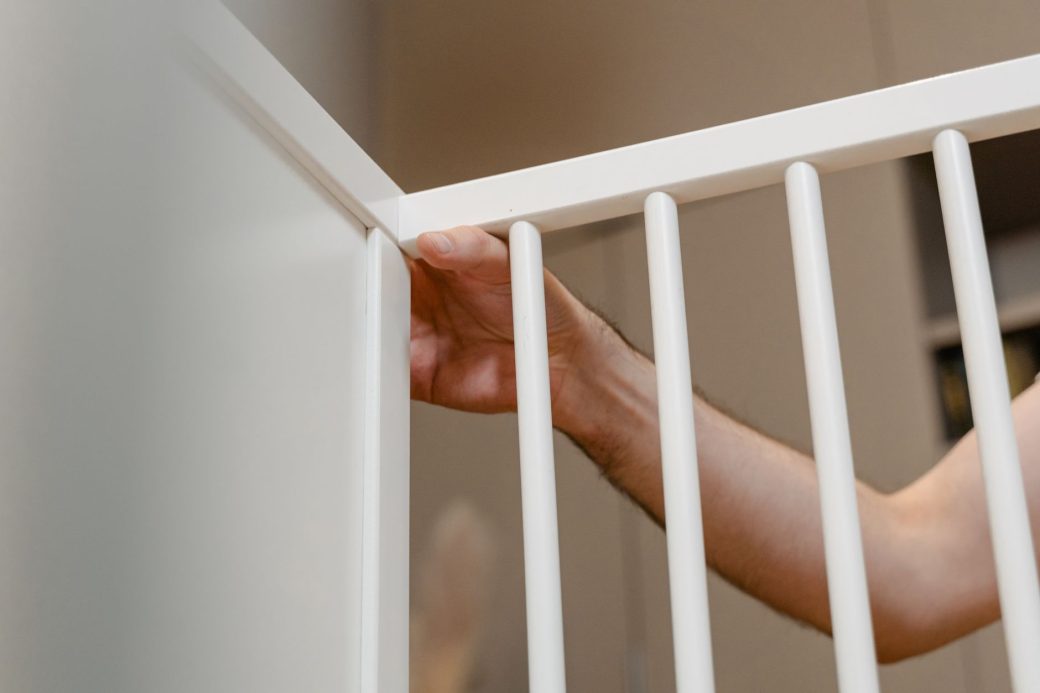
Installing and using it correctly
Even the best gate fails if it is fitted badly. A few minutes of careful installation protects your child for months, so it is worth doing slowly and checking your work.
- Read the instructions fully before starting, since mounting points and tension settings vary between models.
- Fix hardware-mounted gates into solid wall or a stud, not just plasterboard, so the screws hold under real force.
- Check the tension regularly on pressure gates, because pads loosen over time and after each move.
- Test the latch every time until it becomes second nature, and give the gate a firm push to confirm it holds.
- Keep furniture and boxes away from the gate so a determined toddler cannot use them to climb over.
Frequently asked questions
When should I install a baby gate?
Before your baby is fully mobile, usually once they are rolling or starting to crawl, so the barriers are already in place when they need them. Many parents fit gates at the same time they set up a baby monitor and finish other baby-proofing.
When can I take the gates down?
There is no fixed date. Most families keep them until the child reliably uses stairs safely, often around two years, though this varies by child and by how confident they are on steps.
Can I use one gate for both top and bottom of stairs?
The top always needs a hardware-mounted gate. A pressure gate is fine at the bottom, so many homes use two different types rather than one gate moved between spots.
Are second-hand gates safe?
They can be, but check for missing parts, worn pads, weak latches and whether the model has been recalled. A gate that no longer locks firmly is not worth the saving.
Tip: This is general safety guidance to help you plan, not medical or legal advice. Always follow the manufacturer's fitting instructions and any safety standards that apply where you live, and speak to your health visitor or pediatrician if you have concerns about your child's specific needs.
A baby gate is a small purchase that prevents some of the most common household injuries in the early years. Match the gate type to each spot, fit it properly, choose one with a reliable latch, and keep supervising alongside it. For more on baby-proofing, sleep and everyday care, browse the guides on the Babiespedia blog.
Sources and further reading: U.S. Consumer Product Safety Commission, American Academy of Pediatrics (HealthyChildren.org).
Have a question or a topic to suggest?
We read every message. Tell us what you would like to see next on the blog.
Get in touchYou may also like

Newborn: The Complete Guide
What newborns are really like and how to care for one: feeding and safe sleep basics, nappy and skin care, soothing a crying baby, the essentials you truly need, and the signs that mean it is time to call your doctor.

Best Playpen in 2026: Tested Picks by Budget
An honest playpen buying guide covering the main types, the safety standards to check, the features worth comparing, age suitability, and price tiers by budget.

Best Baby Monitor in 2026: Tested Picks by Budget
A no-nonsense baby monitor buying guide covering audio, video and Wi-Fi types, the features that matter, privacy and security tips, and honest price tiers to match your home and budget.